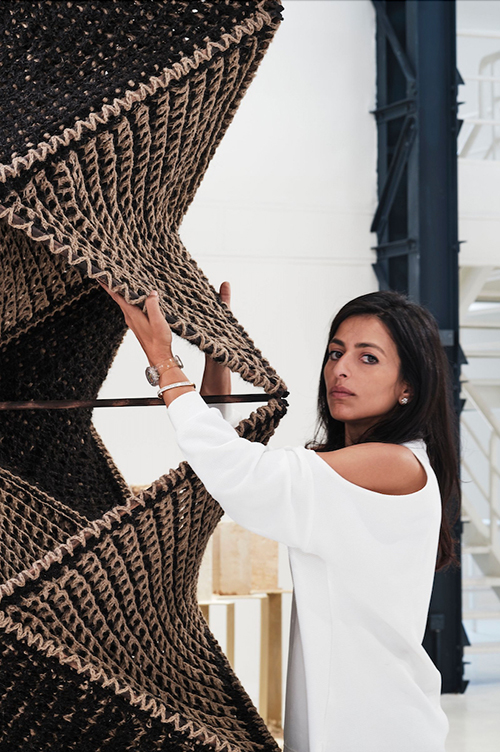
It’s nearly impossible to define Abeer Seikaly, or rather, to put her in a box. The Jordanian-Palestinian says: “I’m just interested in the process of making.”
Perhaps, the word ‘maker’ is the most fitting description for her talents. Her installations juxtapose and blend fine art, architecture, travelling, researching, weaving, journaling, photographing, and more. Plus, Seikaly has Ivy League accolades to her name. In 2021, she attended Yale as the Louis I. Kahn Visiting Assistant Professor.
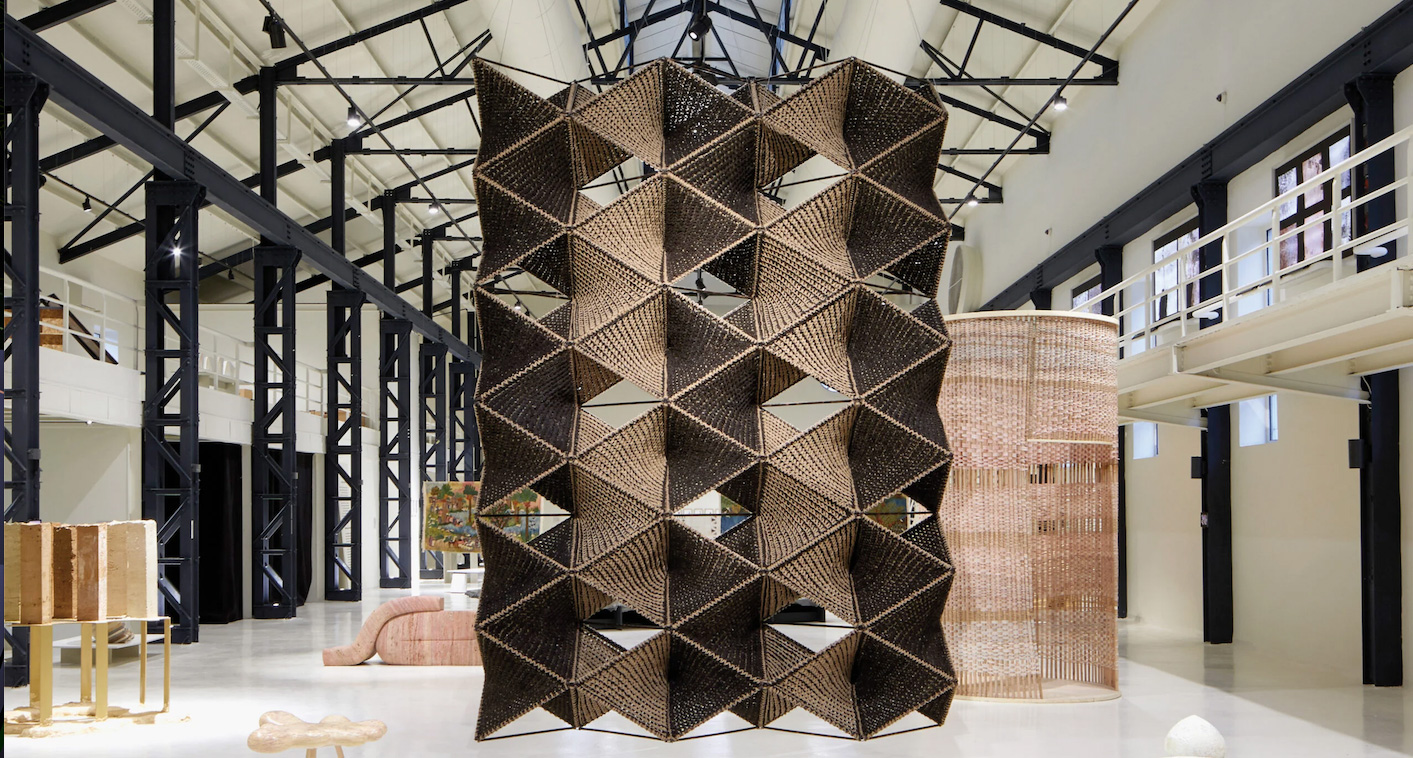
ABOVE: Abeer Seikaly’s Meeting Points (2019), a structural and spatial exploration created from an interplay of materials, construction techniques, and delicate and precise design processes. “It is formed from pre-stressed panels that create a matrix of hexagonal unit cells. This matrix is both stable and self-structuring,” she explains.
One thing that’s clear is that Seikaly works with passion, constantly exploring and pushing new boundaries, both in the metaphorical and geographical sense. “I’m interested in people: how people interact and how we make things and produce things,” she explains. “I’m interested in cultures and different phenomenological aspects. And I love what I do. It’s my life. The way I live. So, for me, it’s not even work. It’s just me exploring this curiosity.”
Her interest in art and architecture emerged at a young age. “I was very lucky to have parents and teachers who recognised my interest and abilities and pushed me to apply to RISD (Rhode Island School of Design), which I really think has become my compass. It’s an experience that stays with me in all I do. Even the things that I didn’t initially apply, or understand back then, have come into use today.”
After RISD, Seikaly returned to Jordan at a time when her ideas about architecture were still, as she puts it, “western-centric”. She worked at an architectural office for just under four years, then moved to Kuwait for a stint at a luxury retailer. With this skillset in collaboration and project management, she founded Studio Abeer Seikaly in Amman in 2010. And this is who she is today.
“The work I’ve been doing involves weaving and textiles, and textile or fabric architecture,” she says. “I’ve been quietly travelling, meeting new people – listening and reflecting on the things that connect us across our region. I’m interested in different cultures and different materials. One of the most important things for me today is untangling the influences that have shaped our lives.”
But more than anything it is nomadic people and traditions that have captivated Seikaly. “My conversations have circled around the Bedouins of the Levant and Jordan, they’ve been the main focus of my work,” she says. “But I’ve also become interested in the Hadar people of the Gulf.”
So, how have these Arab communities affected her work? “In Jordan, I’ve been working with a large Bedouin community researching the craft of tent making, while also doing a lot of investigation into fibres; finding ways to innovate in materiality and integrate traditional practices into my work. It’s been very interesting for me to look at how forms shaped by different climates, cultures, and histories find ways of speaking to each other.”
The result has been several three-dimensional tapestries. “My background in both fine arts and architecture plays a very important role in my practice. I don’t just think about materials, but also the kind of space and how we navigate these spaces.”
There is a nomadic quality to Seikaly’s life too, as she navigates back and forth between her homes in Jordan and the UAE where, at the time of writing, she is undertaking a residency. She explains her work is often seasonal and climate-dependant. Take her weaving work, for example. “The reason I came to the UAE is because I wanted to explore a new fabric structure for ‘interlooping’ in the creation of nets and maritime knots, and that takes me from land to sea. In the past six months, I’ve been taking a deep dive into how to make nets and working with a pearl diver and a master net-maker to develop this new body of work.”
Movement is an essential part of her process and the creations she conceives. “I like to move. It’s who I am. I’m a traveller. The idea of physical movement and how nomadic tribes used to travel in the past fascinates me. In life, nothing is permanent,” she says.
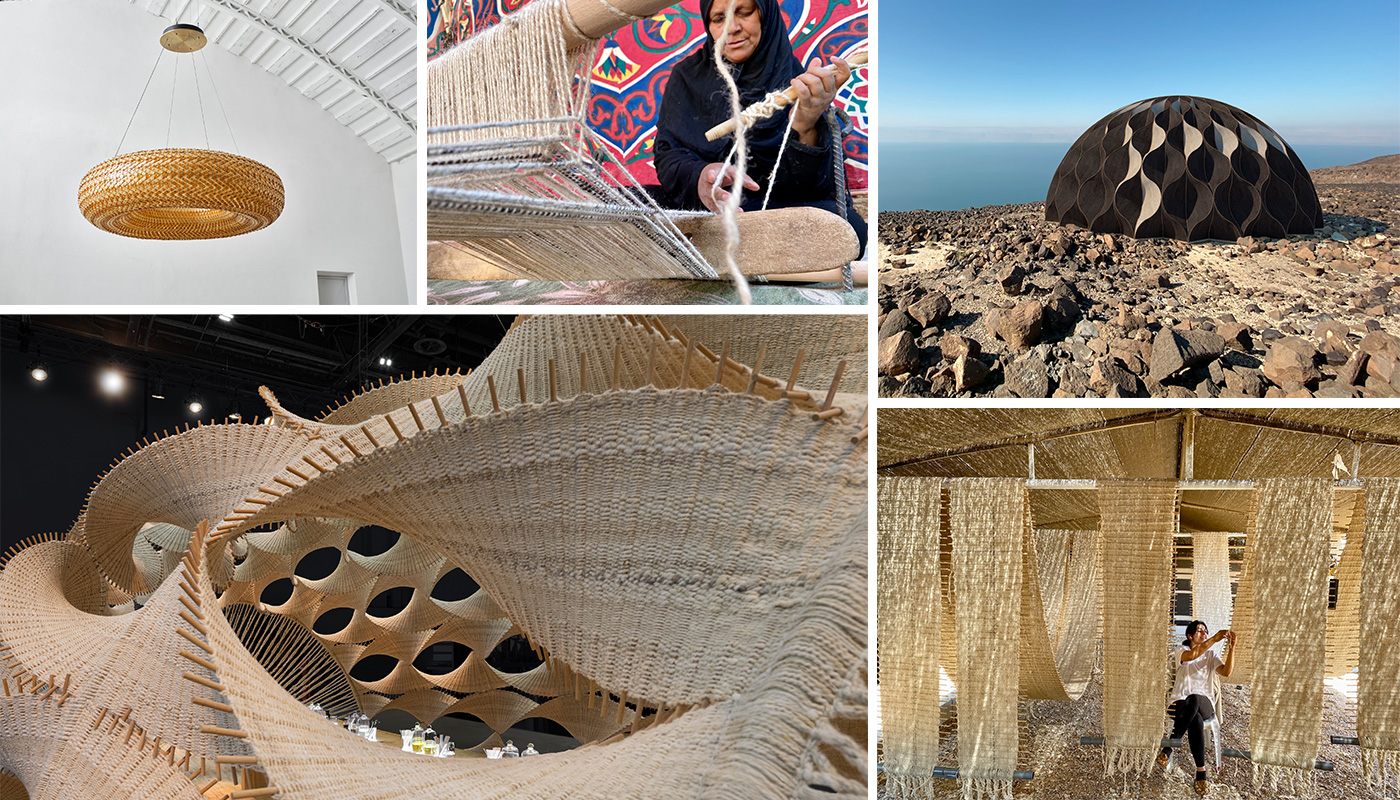
ABOVE: The Weaving a Home (2020) tent near the Dead Sea, on the top right, was made from woven goat hairs. In the centre you can see a Bedouin woman sewing together Terroir (bottom left), which was a mobile cultural space made from tensioned wool that has been twisted into spirals and. On the top left is Constellations 2.0, a suspension light by Seikaly made from Murano glass.
And her future projects? Seikaly lets us into a secret that she hasn’t yet shared: She’s currently working on an installation accompanied by an experimental film for a museum. It’s a project that she describes as an “emotional landscape using a net to create an expression of a layered consciousness.”
“Essentially, I’m building a suspended net that falls into a body of water and absorbs water through a capillary action,” she explains. “Through the interaction of the net with wind and light, it creates shading and cooling. So, it becomes both an aesthetic art piece and a functional object that is handmade by a master net-maker. This is my way of saying: we’re not using the net as a survival tool right now, because it’s forbidden to use nets in the sea today, especially in Abu Dhabi. So how about utilising those skills and finding a new way to adapt and respond to a current issue that we need to address? A climatic issue.”
PHOTOGRAPHY: David Walters & Rami Mansour
Related Posts