“The Global 6000 underwent a full interior and exterior transformation,” explains Jim Dixon, Managing Partner & Creative Director, Yachts & Aviation at Winch Design. “What has been preserved is the structural integrity and proven platform of the Global 6000. What’s been updated is virtually everything else, from spatial layout and materials to visual identity and atmosphere.”
“Nearly every visible aspect was reimagined to create a more open, contemporary and emotionally resonant flying experience,” he continues. “The result is an aircraft that feels entirely new, while remaining fit for its demanding operational role.”
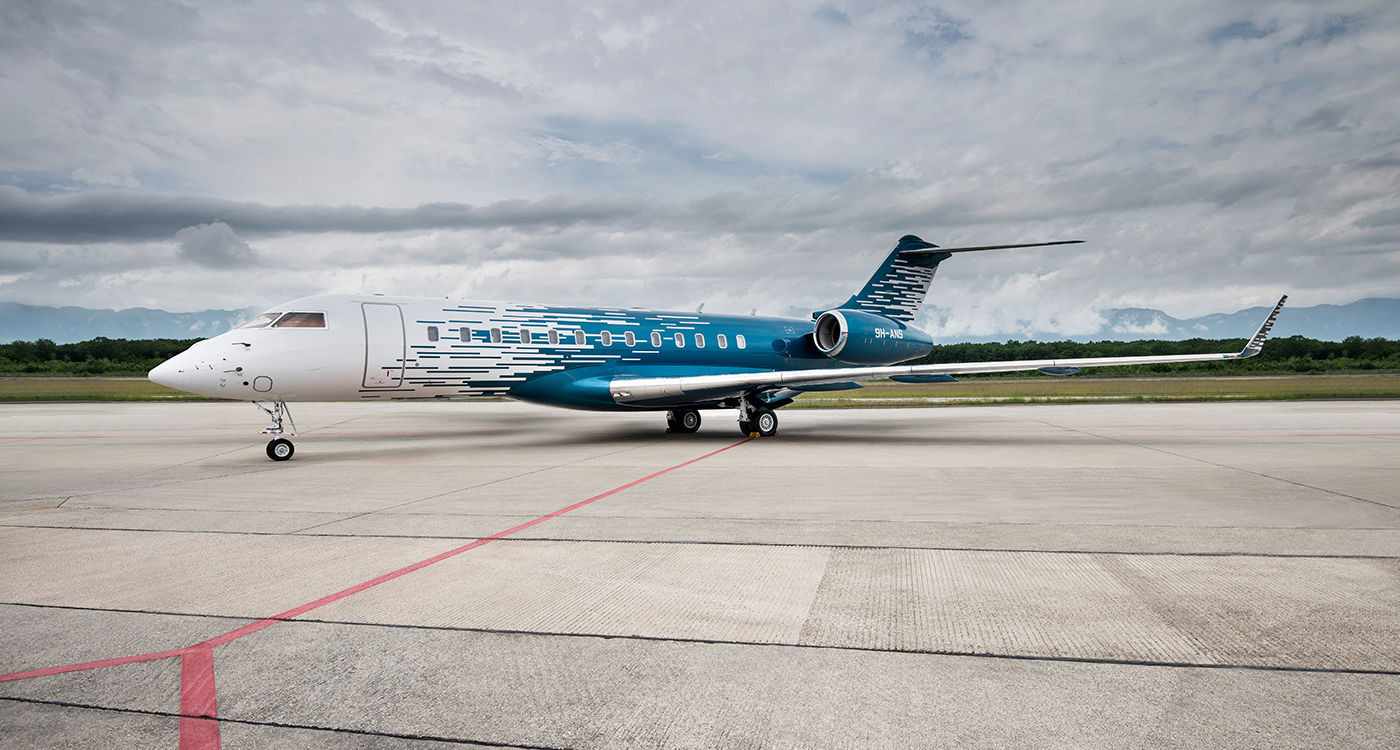
Starting with the exterior of this impressive rework, bold livery in pearlescent white graphics – emblazoned on the bright, metallic, teal-coloured fuselage – gives this jet a striking, dynamic appearance; a major contrast compared to more traditional ‘sweep’ exteriors that commonly dominate the runways. The graphic elements also extend to the inside of the winglets, allowing the design to remain visible even from inside the cabin, bringing the interior and the exterior together, and underneath the horizontal stabilisers.
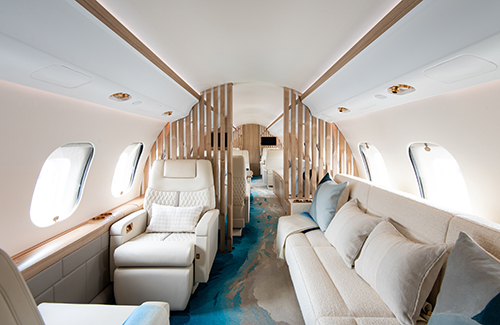
ABOVE: The use of louver screens is a novel way of partitioning sections. While the light, neutral-coloured leathers are complemented by straight-grain walnut timber and gold almond metal accents.
The Winch Design team worked closely with General Atomics of Munich to ensure the pattern would be applied correctly, even going so far as to be on-site at the tape-up before the paint job was applied.
For the interior, Winch Design was tasked with creating an inviting, relaxed environment that did not feel like an aircraft interior. At the same time, it had to also be strong enough to be able to withstand the rigours of a busy charter schedule.
“Our creative vision focussed on transforming the cabin into a light, open and residential-feeling space,” Dixon explained, “using thoughtful material choices and spatial design to enhance both comfort and functionality.”
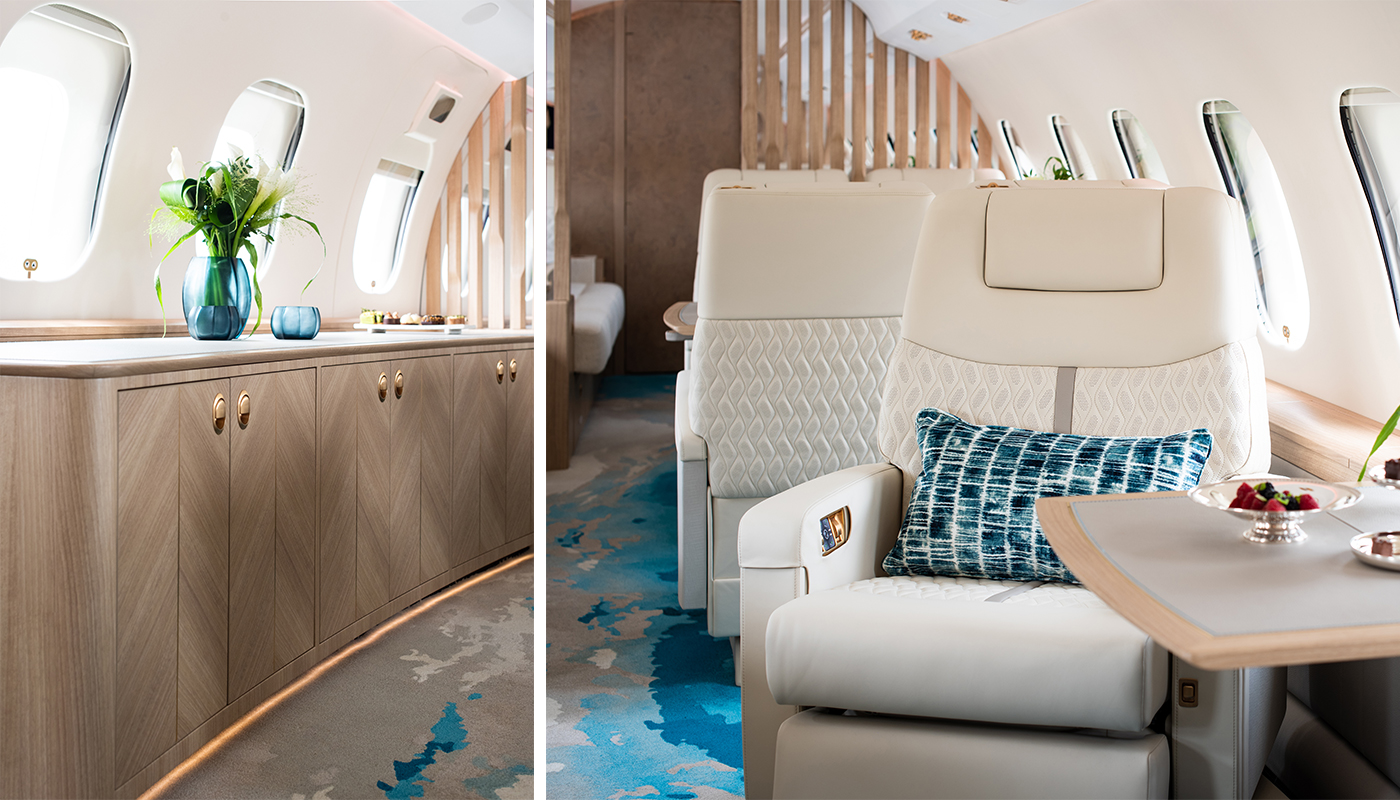
Neutral leathers, warm metallic accents, and fine veneers create a refined yet welcoming aesthetic. The Aft Lounge bulkhead features a bespoke walnut veneer panel – the only piece of real wood introduced in the refit – that serves as the cabin’s natural focal point. To achieve the desired natural finish while still adhering to strict aviation safety standards, an entirely new oil treatment was implemented. Developed by F/LIST, this treatment not only passed demanding fireproofing requirements, but delivers the warmth and authenticity of real wood without compromising the aircraft’s compliance with regulations.
Meanwhile, the mid and forward bulkheads are treated as vertical, slatted screens of light wood and mirror, inspired by Japanese shou sugi ban screens, replacing the previous solid partitions to provide privacy and transparency, while also visually connecting the different cabin zones, bestowing a sense of openness and continuity throughout the aircraft.
“These visually transformative elements required a high level of coordination, as they involved the careful repositioning of switches, exit signs and other system integrations,” said Dixon. “In addition, we had to ensure that the internal valance panel – crucial for maintenance access – could still hinge down unobstructed. Balancing aesthetic ambition with technical functionality was a complex but rewarding process.”
ABOVE: From the outside there’s a cool little easter egg that happens to be an industry-first. The paint job forms a QR code that passengers can scan to see how much of their trip has been offset with carbon credits.
A hand-tufted, one-hundred-percent wool carpet – featuring an undulating, wave-like pattern in bright aqua blue – transitions through subtle gradients inspired by the dynamic natural textures and vibrant colours of the ocean. These tones are then also reflected in the stitching found on the leather inlays of the tables, while the wave motif echoes across the sidewalls and ceiling, manifesting as a 3D ripple effect, reinforcing the visual theme even more.
The design process took six months, and the refit itself spanned just over a year. Remarkably, the aircraft was only out of operation for three months, highlighting the strong collaboration between Winch Design, Bombardier and F/LIST, and the efficiency of the planning and execution phases.
“The Winch Design team thoroughly enjoyed the fast turnaround of this bespoke interior and exterior refit,” concludes Dixon, “and we are delighted with the striking end result.”
Related Posts